

FLUX 4.0 – rethinking the future of tourism
19.05.2026SparksWe are proud to announce the begin of Flux 4.0 – Managing Flows for Sustainable Tourism, a project shaped by shared vision and a strong commitment to creating meaningful change.
Led by Arctur d.o.o., the consortium brings together 12 partners from academia, research, and industry:Biotechnical Faculty (University of Ljubljana), School of Economics and Business (University of Ljubljana), Faculty of Electrical Engineering and Computer Science (University of Maribor), Faculty of Computer and Information Science (University of Ljubljana), Faculty of Tourism (University of Maribor), Faculty of Tourism Studies – Turistica (University of Primorska), Igea d.o.o., Inova IT d.o.o., National Institute of Chemistry, Semantika d.o.o., and University of Nova Gorica.
The project was submitted under the Public Call for the Implementation of Research and Development Programmes TRL 3–6.Each partner has contributed their knowledge, experience, and conviction about what is needed to build smarter, more sustainable, and more resilient tourism for the future.
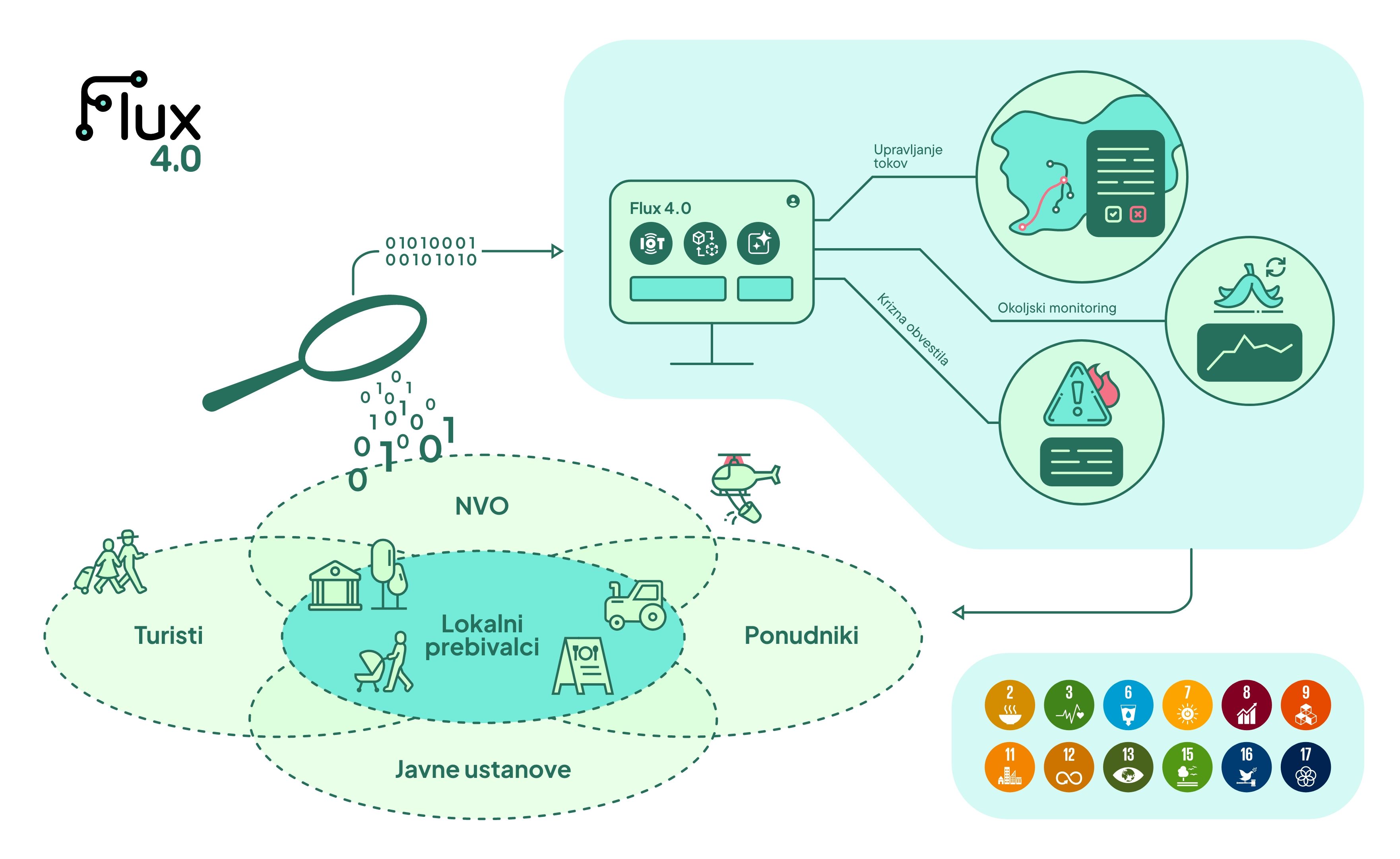
Starting from the challenge identified by the European Union as “unbalanced tourism” — the uneven distribution of tourist flows — the Flux 4.0 project focuses on identifying data sources, harmonising them, and developing solutions that will support the smart management of visitors, reduce the environmental footprint, and strengthen the resilience of tourism in times of crisis.
The main objective of the project is to establish a robust data and system infrastructure for the implementation of responsible artificial intelligence in tourism. This foundation will enable the reliable integration of verified information and content into broader platforms or applications. A robust, useful, and adaptable system will support advanced technological solutions for the tourism industry.
Our story began in 2018, with the Tourism 4.0 project within the same Programme. The results speak for themselves. Flux 4.0 represents a new and significant opportunity to shape a smarter, more sustainable, and more resilient future for tourism over the next three years.